AI Agents for Small Business: What They Actually Do
AI agents for small business can build websites, create content and run campaigns. What to delegate, how many firms use them, what the EU AI Act requires.
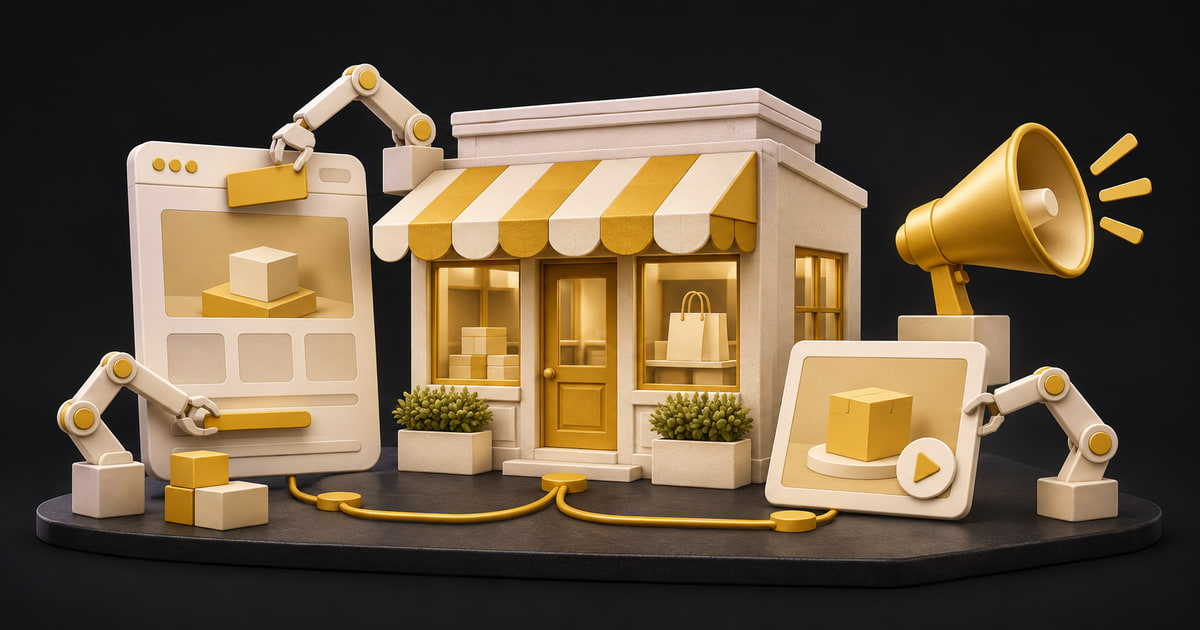
AI agents for small business are software that takes a goal, such as building a website or running a campaign, and carries out the steps using available tools. You define the result, budget and limits. In September 2026, 58% of US small employers used them at least occasionally.
In short
- 58% of US small businesses with 2 to 99 employees used AI agents regularly or occasionally in September 2026 (SBE Council).
- In 2025, 15.7% of Italian SMEs with 10 to 249 employees used at least one AI technology (Istat).
- EU AI Act: transparency duties since August 2, 2026, and high-risk rules for uses such as CV screening and credit scoring from December 2, 2027 (European Commission).
What do AI agents for small business actually do?
For a small business, agents can cover four jobs: strategy, a website or online store, images and video, and AI-driven ad campaigns. Unlike a chatbot, an agent works toward a goal independently, as the article on AI agents vs chatbots explains.
Start with one measurable goal, such as more bookings from a landing page. Give the agent your brand materials, decide what it may do on its own, for example publish posts or spend up to a set budget, and judge it on the results.
How many small businesses already use AI agents?
In SBE Council's September 2026 survey, 58% of US businesses with 2-99 employees reported using AI agents regularly or occasionally.
Istat found that 15.7% of Italian SMEs with 10-249 employees used at least one AI technology in 2025, a figure not directly comparable with the US one because the year, business size and technology measured differ. Among Italian firms with at least 10 employees that used AI, the most common area of use was marketing and sales (33.1%).
What does the EU AI Act change for a small business?
Since August 2, 2026, the transparency duties of Article 50 have applied: people must be told when they are interacting with an AI system, unless it is obvious, and deepfakes must be disclosed. Not every AI-assisted post needs a visible label: see the article on labels for AI-generated video.
The stricter rules for Annex III high-risk uses, such as certain hiring and credit scoring systems, apply from December 2, 2027, a date set by the AI Omnibus that entered into force on July 27, 2026. Building a website or promoting your products and services is not among the high-risk uses the Commission lists.
State1 is one shared economy: users and businesses in a single place. With State1 for Business, launching soon, AI agents will build and promote your business autonomously, from strategy to campaigns on Meta Ads and State1 Ads. You will set the goal and stay in control, while the agents do the rest.
Which job would you delegate first? Find out what State1 for Business agents will take on.
Sources
- Small Business & Entrepreneurship Council (SBE Council), NEW SMALL BUSINESS CHECK UP SURVEY: Main Street Businesses are Powering Through 2026
- European Commission - Shaping Europe's digital future, AI Act
- Istat, Imprese e ICT - Anno 2025 (comunicato stampa)
- European Commission, Transparency obligations under Article 50 of the AI Act
Quick answers
What are good AI agent examples for small businesses?
Do I need technical skills to delegate tasks to AI agents?
Where do AI agents still need a human?
Build your business with AI agents
State1 for Business is launching soon: join the waitlist and be among the first to try it.